Discover unforgettable experiences in the Land of the Thunder Dragon.
Looking for meaningful things to do in Bhutan? The Bhutan Experience Map brings together sacred festivals, mountain journeys, village life, food, crafts, wildlife, traditional sport, wellness and unusual local experiences in one practical guide for planning a deeper journey through the kingdom.
Explore Things to Do in Bhutan by Interest
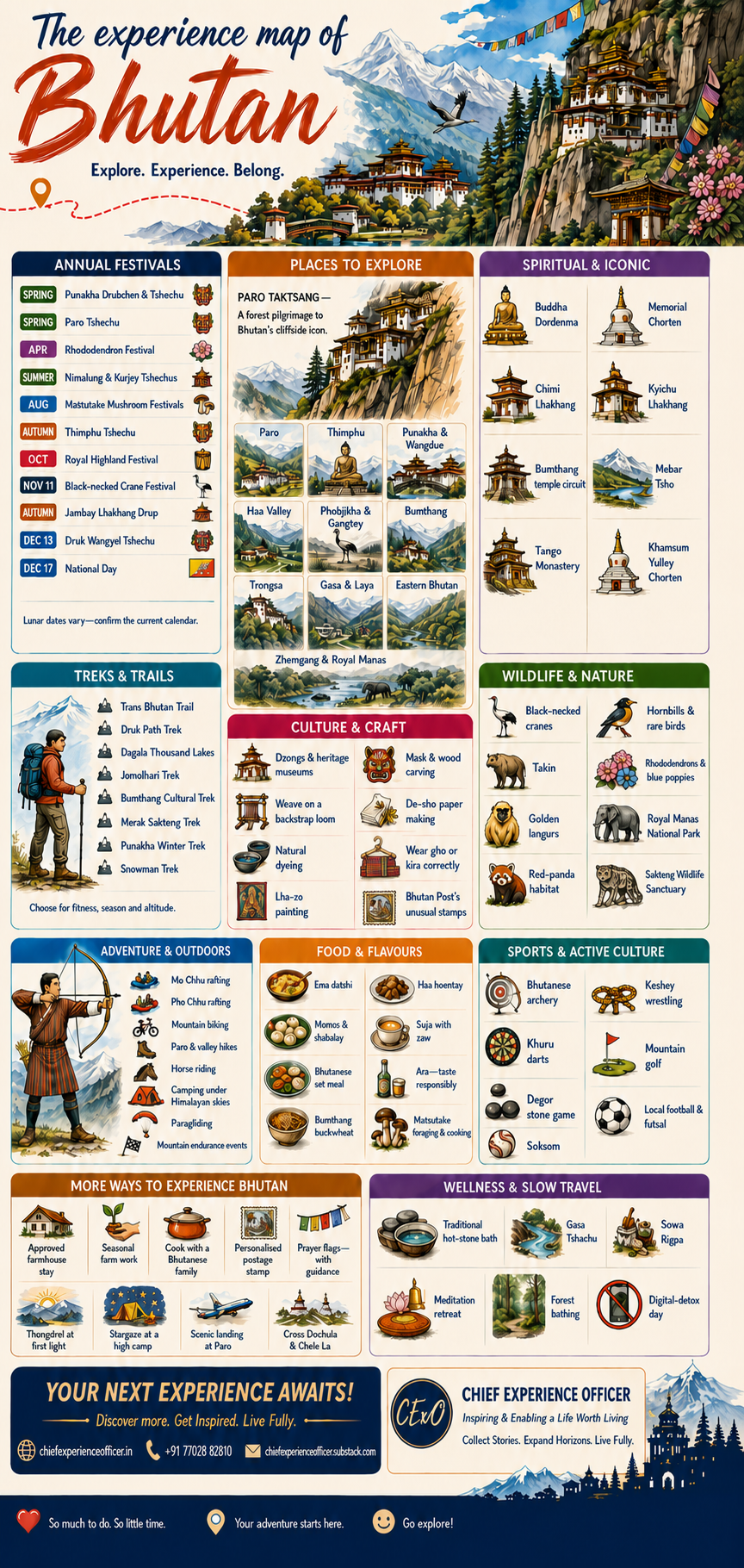
Bhutan is not a country to rush through. It is a place where a mountain road becomes part of the journey, a monastery visit becomes a lesson in attention, and a shared bowl of chilli and cheese becomes an introduction to a family, valley and way of life.
This Bhutan Experience Map brings together 195 ways to experience the kingdom: sacred festivals, high-altitude treks, village stays, wildlife encounters, regional food, living crafts, traditional sport, restorative baths and the rare moments that cannot be reduced to sightseeing.
Choose experiences by interest, then build them into a route that respects Bhutan’s mountain geography, living culture and deliberate pace. You do not need to do everything. You need to choose what will make Bhutan meaningful to you.
Using external experience links: CExO has selected official venues and established experience providers for planning convenience. Provider links are examples, not endorsements or guarantees. Confirm current licensing, availability, inclusions, safety standards, cancellation terms and prices before booking.
How to Use This Map
- Start with an anchor experience — Choose one experience you would be genuinely disappointed to miss—a festival, Tiger’s Nest, cranes, a trek, a village stay or a craft tradition—then build around it.
- Plan by valley, not by checklist — Bhutan’s roads are slow and mountainous. Cluster experiences in Paro, Thimphu, Punakha, Haa, Phobjikha, Bumthang or the east instead of adding long daily transfers.
- Leave breathing room — One major experience, one lighter encounter and unstructured time is often enough for a day. The country rewards pauses, conversations and repeat observation.
- Use your guide as an experience designer — A certified Bhutanese guide can translate rituals, arrange permissions, find safe routes, connect you with hosts and explain what a general travel list cannot.
- Verify the variable experiences — Confirm festival dates, wildlife season, trek condition, operator availability, road access, altitude, age limits and photography rules before committing.
Festival dates, trail access, weather, permits and operator availability can change. Verify the current details with official sources and your certified Bhutanese guide before travelling.
Annual Events & Festivals
Bhutan has more than 160 festivals in a typical year. Religious festival dates follow the Bhutanese lunar calendar and can change, so use this section to choose the kind of celebration you want, then confirm the current calendar before fixing flights.
Paro Tshechu
See several days of sacred cham mask dances in Rinpung Dzong, culminating in the pre-dawn unfurling of a giant thongdrel. It is one of Bhutan’s grandest and most visitor-friendly religious festivals.
Thimphu Tshechu
Join the capital’s largest annual gathering for mask dances, blessings, music and a vivid display of Bhutanese dress. Arrive early, stay for several hours and treat the event as a living religious occasion—not a stage show.
Punakha Drubchen & Tshechu
Watch a dramatic recreation of Bhutan’s 17th-century defence, followed by sacred dances in the extraordinary riverside Punakha Dzong. The winter setting is milder than Bhutan’s higher valleys.
Jambay Lhakhang Drup
Travel to Bumthang for one of the kingdom’s most distinctive temple festivals, known for a night-time fire blessing and sacred dances. Some rites are sensitive; follow your guide’s instructions on viewing and photography.
Ura Yakchoe
Experience an intimate village festival in Ura, where a revered relic is displayed and the community gathers for rituals and dances. It pairs beautifully with a stay in Bumthang’s pastoral Ura Valley.
Nimalung Tshechu
Attend a summer tshechu at Nimalung Monastery in Chumey, Bumthang. The green-season landscape, elaborate costumes and relatively rural setting make it a quieter alternative to the largest western festivals.
Kurjey Tshechu
Gather at one of Bhutan’s holiest temple complexes to honour Guru Rinpoche through ritual dances and community worship. Combine it with Jambay Lhakhang, Tamshing and a Bumthang valley walk.
Dochula Druk Wangyel Tshechu
Watch contemporary sacred dances at high-altitude Dochula against a Himalayan backdrop. The December festival honours Bhutanese service and history; clear weather can add spectacular mountain views.
Black-necked Crane Festival
Celebrate Phobjikha Valley’s winter visitors at Gangtey Monastery on 11 November. Local children perform crane dances, conservation groups share their work and the valley’s relationship with the birds comes alive.
Royal Highland Festival
Journey to Laya for highlander culture, yak competitions, local food, music, traditional dress and mountain sport. Reaching Laya involves significant travel and hiking, so this is an expedition rather than a casual festival stop.
Matsutake Mushroom Festivals
Visit Genekha or Ura in August for guided mushroom picking, cooking, local sport and cultural performances. The experience connects forest conservation with a seasonal rural livelihood.
Rhododendron Festival
See Bhutan’s spring flora celebrated at the Royal Botanical Park in Lamperi through nature walks, cultural programmes, crafts and traditional games. Bloom timing varies with weather and elevation.
Bhutan Echoes Literature Festival
Listen to Bhutanese and international writers, thinkers and artists discuss literature, culture and the Himalayan imagination in Thimphu. Check the organiser’s current programme and venue before planning around it.
Bhutan Bird Festival
Head beyond the western circuit to Zhemgang for bird walks, conservation talks, local culture and community-led ecotourism. The region records hundreds of bird species and borders major protected areas.
Tour of the Dragon
Watch—or, if properly trained, enter—Bhutan’s demanding one-day mountain-bike race from Bumthang towards Thimphu. The event compresses high passes, long descents and serious endurance into one extraordinary ride.
National Day
If your journey coincides with 17 December, experience Bhutan’s most important civic celebration through public ceremonies, cultural performances and a powerful sense of national identity. Access arrangements and venue change, so confirm locally.
Spirituality & Living Traditions
In Bhutan, spirituality is woven into everyday life. These experiences are most meaningful when approached slowly, with modest dress, quiet observation and guidance about what may—or may not—be photographed.
Make the pilgrimage to Paro Taktsang
Hike through pine forest to Tiger’s Nest, Bhutan’s cliff-hugging sacred landmark. The climb, altitude, waterfalls, prayer flags and final temple approach make this both a physical and spiritual experience.
Circumambulate the Memorial Chorten
Walk clockwise with Thimphu residents, turn the large prayer wheels and observe a daily rhythm of devotion. A short visit at different times of day reveals more than a rushed photo stop.
Meditate below Buddha Dordenma
Sit in the vast meditation hall or pause on the hilltop overlooking Thimphu. The scale of the statue, the thousands of smaller Buddhas within it and the valley view create a memorable place for stillness.
Visit Chimi Lhakhang
Walk through paddy fields to the fertility temple associated with the ‘Divine Madman’. Your guide can explain Bhutan’s candid phallus symbolism, the blessing tradition and why humour and faith coexist here.
Enter Kyichu Lhakhang
Experience one of Bhutan’s oldest and most revered temples in Paro. Look for ancient murals, prayer wheels and the quiet devotional atmosphere rather than treating the complex as another monument.
Receive the atmosphere of Gangtey Goenpa
Visit the hilltop monastery above Phobjikha, listen for monastic chanting when accessible and understand the valley’s spiritual relationship with black-necked cranes.
Follow the Bumthang temple circuit
Link Jambay Lhakhang, Kurjey Lhakhang and Tamshing Lhakhang with stories of Guru Rinpoche and Pema Lingpa. The circuit gives cultural context to the valley’s sacred geography.
Stand beside Mebar Tsho
Visit the narrow river gorge called the Burning Lake, where treasure revealer Pema Lingpa is believed to have emerged holding sacred objects and a still-burning lamp. Observe from safe, designated areas.
Hike to Chagri Dorjeden Monastery
Walk through forest north of Thimphu to a major meditation and monastic centre founded in the 17th century. Ask whether visitor access is possible on the day.
Climb to Tango Monastery
Take the roughly two-hour forest hike to this important Buddhist learning centre above Thimphu. The path, architecture and chance to learn about monastic education make the journey worthwhile.
Visit Kila Goenpa Nunnery
Descend from Chele La to a cluster of cliffside meditation houses and meet Bhutan’s living tradition of female monastic practice, where access and daily schedules allow.
Hike to Khamsum Yulley Namgyal Chorten
Cross the Mo Chhu, walk past rice terraces and climb to a richly symbolic chorten commissioned for peace. The rooftop view over Punakha is part of the reward.
Light butter lamps and turn prayer wheels
With your guide’s help, make a simple offering, turn wheels clockwise and understand the prayers embedded in everyday movement. Small acts often reveal Bhutan more deeply than another checklist sight.
Discuss Buddhism with a monk, nun or scholar
Arrange a respectful, translated conversation through your guide or host. Focus on daily practice, compassion, monastic education or the relationship between Buddhism and modern Bhutan; never assume private access.
Dzongs, Museums & Heritage
Bhutan’s fortresses are active religious and administrative spaces, not empty ruins. Opening hours, interior access, dress and photography rules can change when government or monastic functions are taking place.
Punakha Dzong
Explore Bhutan’s celebrated riverside fortress at the confluence of the Pho Chhu and Mo Chhu. Cross the traditional bazam bridge and look closely at murals, courtyards, woodwork and seasonal jacaranda.
Tashichho Dzong
Visit Thimphu’s seat of government and the central monastic body when public access is open. Evening light on the white walls and gilded roofs makes the exterior especially striking.
Rinpung Dzong
Walk through Paro’s monumental fortress-monastery, then descend towards the traditional bridge. During Paro Tshechu, its courtyard becomes one of Bhutan’s most important festival spaces.
Trongsa Dzong
Explore the vast fortress that historically controlled east–west movement through Bhutan. Its layered courtyards, strategic position and connection to the monarchy reward an unhurried visit.
Jakar Dzong
Stand above Bumthang’s Chokhor Valley at the ‘Fortress of the White Bird’. The panoramic location helps explain why dzongs were administrative, defensive and religious centres at once.
Trashigang Dzong
Visit the commanding eastern fortress above the confluence of two rivers. It is an excellent cultural anchor for journeys towards Radhi, Trashiyangtse, Merak or Sakteng.
Lhuentse Dzong
Travel deep into the northeast to a dramatic ridge-top dzong associated with Bhutan’s royal lineage. Pair it with Khoma’s celebrated kushuthara weaving tradition.
Wangdue Phodrang Dzong
See the meticulously reconstructed fortress overlooking the Punatsang Chhu. Its revival after a devastating fire offers a powerful story of craftsmanship, memory and national restoration.
Simtokha Dzong
Visit one of Bhutan’s oldest surviving dzongs near Thimphu. Its compact scale and detailed murals make it easier to study the architectural vocabulary repeated across the kingdom.
Drukgyel Dzong
Explore the restored historic fortress in upper Paro Valley and, on a clear day, look towards sacred Jomolhari. Combine it with nearby villages and Kyichu Lhakhang.
National Museum of Bhutan
Enter Paro’s circular Ta Dzong to understand Bhutanese history, natural heritage, ritual objects, arms, textiles and regional culture before travelling deeper into the country.
Royal Heritage Museum, Trongsa
Continue from Trongsa Dzong to the Ta Dzong museum for the story of Bhutan’s monarchy and the strategic role of central Bhutan.
Royal Textile Academy & Textile Museum
Study regional weaves, royal textiles, natural dyes and the evolution of gho and kira. Changing exhibitions and workshops show that Bhutanese textiles are a living design tradition.
Folk Heritage Museum
Step inside a traditional rural house in Thimphu to see household objects, farming tools, food traditions and domestic architecture presented in context.
Simply Bhutan
Try a compact living-museum introduction to archery, local customs, food, dance and traditional household life. It works well early in a first Bhutan journey, especially for families.
Bhutan Postal Museum
Trace Bhutan’s remarkable stamp history—from sculptural and silk issues to unusual sound and 3D formats—then explore the tradition of turning postage into cultural storytelling.
Short Hikes & Scenic Walks
These half-day and day walks give non-trekkers a strong taste of Bhutan’s forests, ridges, monasteries and valleys. Times are approximate; altitude, weather, trail condition and personal fitness can change the day considerably.
Dochula to Lungchutse Lhakhang
Climb through rhododendron forest from Dochula to a ridge-top temple, often with sweeping Himalayan views in clear weather. Allow roughly two to three hours for the hike itself.
Changangkha to Buddha Point
Walk an easy forested trail above Thimphu between Changangkha and Buddha Dordenma. It is a gentle acclimatisation outing with broad views of the capital valley.
Gangtey Nature Trail
Follow a short downhill trail through pine forest and meadow into Phobjikha Valley. It is one of Bhutan’s most accessible landscape walks and pairs naturally with the crane centre and Gangtey Goenpa.
Paro Taktsang day hike
Give the Tiger’s Nest journey a full day rather than racing the climb. Pause at viewpoints, acclimatise, cross the waterfall ravine and enter the sacred complex with enough energy to appreciate it.
Chele La and Kungkarpo walk
Explore the high pass above Paro and Haa, then walk towards ridge-top sacred sites and prayer-flag viewpoints. Snow, wind and visibility are highly seasonal.
Zuri Goenpa hike
Walk above Paro through forest and past Zuri temple, linking elevated valley views with Rinpung Dzong or the National Museum. Route and duration vary by start point.
Bumdra ridge hike
Climb from the Paro side towards high meadows and Bumdra’s ‘Cave of a Thousand Prayers’. Do it as a demanding day hike or as part of an overnight route descending via Tiger’s Nest.
Phajoding hike
Ascend above Thimphu to the Phajoding monastic complex and high ridge scenery. The long climb is a serious day outing and can be an acclimatisation test before a trek.
Khamsum Yulley Namgyal walk
Cross a suspension bridge, move beside Punakha’s rice fields and climb to the chorten for a valley panorama. It is one of Bhutan’s best combinations of rural life, architecture and manageable exercise.
Tango Monastery hike
Walk roughly two hours through shaded forest to Tango’s monastic learning centre. The route is close to Thimphu but feels removed from the capital.
Gangtey to Longtey Village
Take the longer high-valley route through forest, ridges and open pasture between Gangtey and Longtey. It offers a fuller Phobjikha experience than the short nature trail.
Bumthang Cultural Hike
Walk between villages, fields and sacred sites in the Chokhor Valley rather than driving from temple to temple. The gentle landscape makes history feel connected.
Ngang Lhakhang to Tahung
Follow a longer Bumthang valley route through rural scenery and forest from the Swan Temple area towards Tahung. Confirm trail condition and transport arrangements with your guide.
Great Treks & Long Trails
Bhutan’s official trekking catalogue ranges from low-elevation cultural routes to extremely demanding expeditions above 5,000 metres. Every trek requires an accredited guide or operator, approved campsites, proper insurance, acclimatisation and current route checks.
Trans Bhutan Trail
Walk selected sections or undertake a long traverse of the restored east–west route once used by pilgrims, traders, messengers and armies. The full trail connects Haa with Trashigang through hundreds of cultural sites.
Bumthang Cultural Trek
Choose an accessible three-day route through villages, fields, forest and temples, with a maximum elevation around 3,120 metres. It is a strong first multi-day trek.
Bumthang Owl Trek
Spend roughly three days moving through blue-pine forest and high ridges above Bumthang, with views towards distant peaks. The official maximum elevation is about 4,000 metres.
Dagala Thousand Lakes Trek
Cross high yak pastures and camp near glacial lakes on a medium-grade route of roughly six days. Clear weather may reveal a broad sweep of Himalayan peaks.
Dagana–Thimphu via Dagala
Traverse from warmer southern approaches into the Dagala highlands and towards Thimphu. This less-common six-day route adds ecological variety to the high-lake experience.
Druk Path Trek
Link Paro and Thimphu through forest, high passes, lakes and monastic landscapes over roughly seven days. It is Bhutan’s classic short high-altitude trek.
Duer Hot Spring Trek
Undertake a hard nine-day Bumthang journey through remote forest and high passes to natural hot springs. Weather, river conditions and altitude make this a serious expedition.
Gangtey Trek
Take an easy four-day route through villages, rhododendron forest and the Phobjikha region, topping out near 3,120 metres. It suits travellers wanting a gentler camping experience.
Jomolhari–Laya–Gasa Trek
Follow a hard 13-day route beneath Jomolhari, across passes around 5,000 metres and into Layap highland country before descending towards Gasa.
Jomolhari Loop
Choose a medium-grade seven-day circuit for high mountain scenery and a concentrated taste of the Jomolhari region without continuing all the way to Laya.
Jomolhari Trek
Spend about ten days walking from Paro’s upper valley towards the sacred mountain, high camps and yak-herding settlements. The route reaches close to 5,000 metres.
Merak Sakteng Trek
Enter eastern Bhutan’s Brokpa highlands on a medium seven-day trek through villages, pasture and the Sakteng landscape. Cultural etiquette matters as much as trail fitness.
Nabji Korphu Trek
Take an easy six-day low-altitude community route through subtropical forest and villages in central-southern Bhutan. It is particularly appealing in the cooler months.
Punakha Winter Trek
Use a short, easy three-day route between warmer western valleys for a first camping experience. Despite its name, the official season extends into spring and autumn.
Salt Trek Route
Trace an old eastern trade path once used to carry salt and goods between lowlands and the interior. The official route is graded hard and takes about eight days.
Samtengang Winter Trek
Walk a low-elevation four-day route through villages and forest near Punakha and Wangdue. It offers cultural scenery without extreme altitude.
Snowman Trek I
Attempt one of the world’s toughest treks only with exceptional preparation. The official 26-day route crosses numerous passes and reaches about 5,320 metres in Bhutan’s remote north.
Snowman Trek II
Take the longer, roughly 28-day Snowman variant through extraordinarily isolated high country. Weather windows are narrow and evacuation can be difficult.
Far-Out East Bhutan Trek
Explore a medium six-day route in Bhutan’s less-visited east, moving through forest, villages and regional cultural landscapes far from the western circuit.
Wild East Rodung La Trek
Follow a historic nine-day route between Bumthang and the east across Rodung La, combining demanding walking with old trade paths and changing ecological zones.
Adventure & Outdoor Experiences
Bhutan’s landscapes invite active travel, but many experiences are seasonal, permit-dependent or operator-led. Use certified providers, insist on safety equipment and treat weather or river cancellations as good judgment rather than disappointment.
Scenic rafting on the Mo Chhu
Choose the gentler Punakha river for a scenic float suitable for many first-timers and families. The route can reveal rice terraces and a river-level view of Punakha Dzong.
Higher-energy rafting on the Pho Chhu
Take the more adventurous Punakha river when water level, season and operator assessment allow. Confirm the rapid grade, minimum age, equipment and rescue arrangements.
Kayak Bhutan’s rivers
Arrange a guided kayak experience on an appropriate graded stretch rather than assuming every river is suitable. Solo craft demand stronger technique and safety support than a group raft.
Mountain-bike through valleys and villages
Ride singletrack, feeder roads or long paved descents in Paro, Thimphu, Punakha, Haa, Phobjikha or Bumthang. Match the route to skill, traffic comfort and altitude.
Take a supported motorcycle journey
Explore winding mountain roads and high passes on a guided or operator-supported motorcycle tour. Road works, rain, fog, falling rocks and long distances require conservative planning.
Camp under Himalayan skies
Spend a night at an approved lowland campsite, forest glamp or high trek camp. Combine dinner outdoors with stars, bird calls and early-morning landscape light.
Ride a horse into remote country
Use a locally arranged horse trek to enter forests, meadows, villages and temple landscapes beyond ordinary roads. Main starting regions include Paro, Punakha, Bumthang and Trashigang.
Fly by helicopter over Bhutan
Charter a sightseeing flight, subject to operational priorities and weather, for aerial views of valleys, sacred peaks and sites such as Taktsang or Drukgyel Dzong.
Catch-and-release golden mahseer
Fish with the required government permit and specialist guidance in approved waters. Bhutan permits recreational mahseer fishing only on a catch-and-immediate-release basis.
Run a Bhutan race
Enter the annual Bhutan International Marathon, attempt the high-altitude Laya Run or follow announcements for the elite Snowman Race. Each demands different preparation and eligibility.
Paraglide above a valley
Where licensed operators, weather and current permissions allow, arrange a tandem flight above valleys such as Ura or Paro. Treat this as a conditional experience and verify it close to travel.
Nature, Wildlife & Conservation
Wildlife sightings are never guaranteed. A good nature experience depends on specialist guides, patience, distance from animals, quiet behaviour and choosing the right habitat and season.
Watch black-necked cranes
Visit Phobjikha or Bumdeling in the wintering season to observe these revered birds from responsible viewpoints. Add the Gangtey crane centre or a local conservation conversation.
Meet Bhutan’s takin
See the kingdom’s unusual national animal at Motithang Takin Preserve above Thimphu, then learn how the species is adapted to steep Himalayan forest.
Birdwatch in Zhemgang
Base a specialist birding journey in Bhutan’s ecotourism capital, where subtropical and temperate habitats support hornbills, pheasants, eagles and many rare species.
Explore Royal Manas National Park
Enter Bhutan’s biodiverse southern ‘crown jewel’ with authorised local arrangements for forest, river and wildlife experiences. The park has recorded hundreds of bird species.
Look for golden langurs
Travel through central-southern habitats around Zhemgang, Royal Manas, Jigme Singye Wangchuck National Park or Phibsoo. Observe quietly and never feed roadside animals.
Track red-panda habitat
Join a specialist guide in temperate forest where red pandas are known to occur. Treat any sighting as a rare privilege, never as a promised tour outcome.
Seek hornbills and the white-bellied heron
Focus a birding itinerary on southern and eastern river forests for rufous-necked and great hornbills, and on carefully selected river habitats for one of the world’s rarest herons.
Walk among rhododendrons
Visit Lamperi’s Royal Botanical Park or higher forest trails during the spring bloom. Species and flowering times shift with elevation and weather.
Search for alpine blue poppies
Join an expert-led high-elevation botanical walk in the brief flowering season to see Bhutan’s national flower in its natural habitat without picking or trampling it.
Discover orchids, butterflies and forest detail
Slow down with a naturalist for Bhutan’s smaller wonders—orchids, ferns, lichens, butterflies and medicinal plants—rather than focusing only on large mammals.
Enter Jigme Dorji National Park
Trek or travel through Bhutan’s largest protected landscape, spanning warm forest to glaciers and sheltering takin, blue sheep, bears and high Himalayan ecosystems.
Experience Sakteng Wildlife Sanctuary
Travel into far eastern Bhutan for blue-poppy habitat, Brokpa culture and mountain biodiversity. Access is remote and should be planned as a dedicated journey.
Explore Jigme Khesar Strict Nature Reserve
Arrange a low-impact nature itinerary in Bhutan’s only strict nature reserve, stretching from Haa towards Samtse and protecting forest, alpine meadow, lakes and rare mammals.
Stop for waterfalls and glacier-fed streams
Build time into road journeys for safe, designated waterfall viewpoints and riverside pauses. Monsoon flows are dramatic but can also bring landslide and road risk.
Village Life & Community Encounters
Rural experiences should benefit hosts and respect their time. Choose approved homestays and community programmes, ask before photographing people or private rituals, and participate only when genuinely invited.
Stay in an approved farmhouse
Sleep in a traditional village home, share meals and see domestic routines that hotels cannot reproduce. Facilities may be simple, but the human connection can be the trip’s strongest memory.
Join seasonal farm work
When hosts invite it, help plant or harvest rice, collect vegetables or undertake a small farm task. The activity and season vary by valley and agricultural calendar.
Cook with a Bhutanese family
Prepare momos, ema datshi, buckwheat noodles or a local salad in a home kitchen, then eat together. Ask how recipes change across generations and regions.
Experience Haa village hospitality
Use an approved homestay to explore high-valley farms, local temples and the regional hoentay dumpling tradition. Haa feels distinct from nearby Paro despite the short map distance.
Live the rhythm of Ura
Walk Ura’s lanes, meet farming families, stay locally and—during mushroom season—join guided foraging. The village is one of Bhutan’s most coherent rural landscapes.
Stay on a Phobjikha farm
Wake to the wide glacial valley, walk between fields and forest, and learn how farming coexists with the winter habitat of black-necked cranes.
Meet the weavers of Khoma or Radhi
Travel east to see backstrap weaving and natural dye traditions in the communities that create prized kushuthara and bura textiles. Purchase directly and respectfully when possible.
Enter Layap highland culture
Hike into Laya for yak-herding traditions, distinctive dress, mountain homes and strong community identity. Plan through local hosts or the Royal Highland Festival framework.
Learn from Brokpa communities
Visit Merak and Sakteng with an experienced guide to understand semi-nomadic pastoral life, dress, livestock and highland beliefs without turning the community into a performance.
Follow the Nabji–Korphu community route
Choose the low-altitude trek for village stays, subtropical nature and community-based tourism in central-southern Bhutan. Cooler months are generally most comfortable.
Food & Drink Experiences
Bhutanese cuisine changes markedly by elevation and region. Ask for local spice levels, try small portions widely and look beyond hotel buffets to homestyle restaurants, markets, farms and cooking experiences.
Eat ema datshi
Begin with Bhutan’s defining chilli-and-cheese stew, ideally beside red rice. Restaurant versions for visitors may be mild; ask before requesting the household heat level.
Compare the datshi family
Try kewa datshi with potato, shakam datshi with dried beef and seasonal mushroom or vegetable variations to understand how one culinary idea changes across ingredients.
Follow the momo trail
Compare steamed and fried dumplings, chilli-cheese fillings and the pan-fried shabalay cousin at local eateries in Paro, Thimphu and beyond.
Share a Bhutanese set meal
Eat red or white rice with several tsem stews, vegetables, meat and ezay chilli paste. A shared spread reveals balance better than ordering one famous dish.
Taste Bumthang buckwheat
Seek khurle pancakes, puta noodles, jangbuli pasta or chogdan polenta in central Bhutan, alongside local cheese and dairy traditions.
Try Haa’s hoentay
Eat the region’s buckwheat dumplings, traditionally filled with turnip greens, cheese and local flavourings. The experience is best paired with a Haa homestay or village meal.
Discover Nobgang’s recipes
Look for Punakha specialities such as ema lumtsho, jatsa gondo and the complex aezey nyergum chilli paste associated with the village of Nobgang.
Explore eastern corn and cheese flavours
Try Trashi Yangtse’s asham thukpa corn porridge, regional chillies and the pungent fermented-cheese character of zoedoe as the food culture shifts east.
Taste Zhemgang’s forest-linked food
With knowledgeable local hosts, explore Khenpa ingredients such as wild potatoes, edible orchids and regional river or forest produce when seasonal and legally harvested.
Eat across southern Bhutan
Try Lhotshampa-influenced rice, roti, lentil stews, curries, pickles and meat dishes to experience a Bhutanese food culture shaped by Nepali and Indian connections.
Drink suja with zaw
Sip salted butter tea with puffed rice or cereal snacks in a home, restaurant or festival setting. It is as much a gesture of hospitality as a beverage.
Taste ara or bangchang responsibly
Sample Bhutanese grain-based alcohol only in a safe setting and in small quantities. Home recipes, strength and ceremonial meaning vary considerably.
Forage and cook matsutake
In Ura or Genekha during the legal season, join a knowledgeable guide to identify mushrooms, harvest sustainably and cook what you find. Never forage independently.
Take a Bhutanese cooking class
Learn a small menu—momos, datshi, buckwheat dishes or salads—then discuss ingredient substitutions you can realistically use at home.
Browse the farmers’ and local-products markets
Explore Thimphu’s produce markets, the CSI Market or OGOP outlets for seasonal vegetables, mushrooms, cheese, tea, honey, rice and packaged products that support Bhutanese producers.
Arts, Crafts & Creative Learning
Bhutan’s zorig chusum—the thirteen traditional arts—are living professions. Observe training, meet practitioners, join a workshop where available and buy authentic work without bargaining away the value of time-intensive craft.
Visit the National Institute for Zorig Chusum
Walk through working classrooms in Thimphu, speak with students when permitted and see how traditional painting, carving, sculpture and other crafts are taught today.
Try lha-zo painting
Learn the disciplined geometry, iconography and mineral-colour tradition behind Bhutanese murals and thangkas. Even a beginner session makes temple art easier to read.
Study par-zo carving and mask-making
Watch wood, slate or stone become architectural detail, scripture blocks or festival masks. Ask how sacred masks differ from decorative souvenirs.
Weave on a backstrap loom
Join a short weaving demonstration or lesson to understand warp, weft, pattern counting and the physical skill behind Bhutan’s textiles.
Learn natural dyeing
See bark, leaves, roots and minerals transformed into yarn colour in places such as Radhi or through textile programmes. Season and practitioner availability matter.
Wear gho or kira correctly
Have a knowledgeable host demonstrate how Bhutan’s national dress is wrapped, fastened and combined with accessories. Treat it as cultural learning, not costume play.
Make de-sho paper
Visit a traditional paper workshop to see Daphne bark processed into resilient handmade sheets once used for scriptures and now used for cards, books and craft.
Explore tsha-zo bamboo and cane work
Handle baskets, quivers, containers and household objects woven especially in eastern Bhutan, and watch a demonstration where a community or workshop offers one.
Try jim-zo clay work
Learn how Bhutanese artisans model sculpture, ritual objects, pottery and architectural elements. Gangzur in Lhuentse is particularly associated with pottery traditions.
Discover shag-zo woodturning
Watch wooden bowls, cups and containers take shape on a lathe, especially in eastern craft centres such as Trashiyangtse.
Meet ornament makers
See troe-ko artisans work with silver, gold and stones for jewellery, dress fittings and ritual pieces. Ask about symbolism, material authenticity and export rules.
Understand gar-zo blacksmithing
Connect Bhutan’s metalwork tradition with agricultural tools, household objects and the historic iron-chain bridges associated with Thangtong Gyalpo.
See tshem-zo embroidery and appliqué
Study the needlework used for clothing, boots and monumental thongdrel textiles. Festival pieces may take teams of artisans years to complete.
Join a VAST art experience
Visit Thimphu’s contemporary-art movement for exhibitions, artist conversations or a scheduled workshop in drawing, acrylic, pastel or watercolour.
Learn Bhutanese music, dance or mandala pattern
Arrange a folk-dance or instrument introduction, or make a coloured-rice motif based on auspicious symbols. These are engaging ways for adults and children to learn visual rhythm and meaning.
Sports, Games & Active Culture
Traditional sport in Bhutan is social theatre: competition comes with songs, dances, jokes and long communal pauses. Participate only with instruction and a safe playing area—many traditional implements are genuinely sharp or heavy.
Learn Bhutanese archery
Pick up a bow at a hotel, living museum or supervised range and discover why hitting a distant target is only part of the experience.
Watch a live archery match
Spend time at Changlimithang or a village ground watching teams shoot, celebrate, tease opponents and negotiate the rhythm of a match that may last for hours.
Play khuru
Throw large Bhutanese darts at a distant target under supervision. Team celebration and camaraderie matter as much as accuracy.
Try soksom
Learn the herders’ target game resembling javelin, using appropriate safe equipment and a local instructor.
Play degor
Throw a flat stone towards a small wooden target in this traditional team game. It looks simple until distance, balance and precision take over.
Attempt pungdo
Try Bhutan’s stone shot-put tradition with an instructor who selects a safe weight and throwing area.
Learn keshey wrestling
Observe or join a carefully supervised introduction to Bhutanese belt-style wrestling, where opponents aim to unbalance and throw each other.
Play nine holes in the Himalayas
Arrange a round at a course such as Royal Thimphu Golf Club, Haa Golf Club, India House or Drakpoi. Confirm visitor access and equipment in advance.
Join football, futsal or basketball
Ask a host or guide about a friendly local game or public court. Modern youth sport provides a different window into Bhutan than heritage sites alone.
Enter—or cheer—a mountain endurance event
Follow the Bhutan International Marathon, Laya Run, Tour of the Dragon or occasional Snowman Race as participant or spectator, according to fitness and event rules.
Wellness & Slow Travel
Bhutan’s strongest wellness experiences are place-based rather than packaged: heat, herbs, mineral water, silence, forest, prayer and unhurried hospitality. Medical claims should be treated cautiously; choose clean, reputable facilities.
Take a traditional hot-stone bath
Soak in a wooden tub of water infused with artemisia and heated by fire-roasted river stones. Farmhouses, hotels, camps and specialist bathhouses may offer the experience.
Soak at Gasa Tshachu
Journey to the riverside hot springs below Gasa for a distinctly local wellness pilgrimage. Access, bathhouse condition and river routes should be checked before travel.
Seek a tshachu or menchu beyond Gasa
Ask about approved access to other hot springs or mineral waters in Bumthang, Zhemgang, Punakha or southern Bhutan. Facilities range from basic to developed.
Explore Sowa Rigpa
Visit or enquire at the Institute of Traditional Medicine Services in Thimphu to learn about Bhutan’s medicinal-herb and holistic-healing tradition. Treat any consultation as complementary, not emergency care.
Undertake a meditation retreat
Choose a recognised retreat centre or guided practice that welcomes visitors. A few hours, a silent day or a longer programme can change the pace of the entire journey.
Practise yoga with a Himalayan view
Join a Thimphu class, a hotel session or a private practice in a suitable quiet place. High altitude changes breathing and exertion, so begin gently.
Book a restorative spa or massage
Use a reputable hotel or wellness centre in Paro, Thimphu or Punakha for recovery after hikes and long drives. Ask which elements are genuinely Bhutanese and which are general spa treatments.
Take a forest-bathing walk
Walk slowly with no destination agenda, noticing resin, birds, moss, water and wind. Bhutan’s protected forests make deliberate attention a meaningful experience in itself.
Build a digital-detox day
Choose a farmhouse, retreat, monastery-view stay or quiet valley; switch off the phone; walk, read, journal and share meals. Bhutan rewards leaving unscheduled space.
Scenic Drives, Passes & Viewpoints
Road distances in Bhutan are deceptive: mountain curves, construction, weather and photo stops turn short map distances into long journeys. Plan the drive as an experience, not merely a transfer.
Land at Paro International Airport
The approach between mountains is an unforgettable introduction to Bhutan. Keep your camera stored when required and enjoy the shift from Himalayan terrain to the art-filled terminal.
See the Himalayas from Dochula
Stop among 108 chortens for one of Bhutan’s classic mountain panoramas. Winter often brings the clearest skies, while spring adds rhododendrons.
Cross Chele La
Drive to one of Bhutan’s highest motorable passes for prayer flags, alpine air and views into Paro and Haa valleys. Snow and fog can transform or close the experience.
Pause at Pele La
Use this central pass as a landscape transition between western valleys and Trongsa/Bumthang. In clear conditions, the ridge opens broad mountain and pasture views.
Cross Yotong La into Bumthang
Watch vegetation and settlement patterns change on the high pass between Trongsa and Chumey, then descend into Bhutan’s spiritual heartland.
Drive Thrumshing La
Travel one of Bhutan’s most dramatic ecological transitions, moving between high forest and subtropical east. Fog, rain and road conditions can be intense.
Descend into Haa Valley
Approach Haa over Chele La or via the valley road for terraced fields, traditional houses, forests and a slower rhythm than neighbouring Paro.
Look across Phobjikha Valley
Stop at high viewpoints before descending into the vast glacial basin. Early morning and late afternoon bring softer light and a stronger sense of scale.
Follow Bumthang’s four valleys
Move through Chokhor, Tang, Ura and Chumey for changing combinations of temples, farms, pine forest, buckwheat and weaving villages.
Take the long road east
Continue beyond Bumthang to Mongar, Trashigang, Trashiyangtse and Lhuentse. The journey reveals major ecological and cultural shifts that a western-circuit trip misses.
Unique Bhutan Experiences
These are the details travellers remember years later: a strange stamp, a dawn blessing, a highland portrait, a quiet conversation. Availability depends on hosts, permissions and season, so arrange rather than demand.
Create a personalised Bhutan postage stamp
Ask Bhutan Post about its personalised-stamp service, use a photograph to create a sheet and—if the current denomination is valid for postage—mail a postcard home. Confirm service location and production time.
Collect Bhutan’s unusual stamps
Look for silk, three-dimensional, sculptural or playable stamp issues that made the kingdom famous among philatelists—small objects with outsized cultural imagination.
Follow Bhutan’s phallus iconography
Visit Chimi Lhakhang, painted village houses and a specialist shop with a guide who can explain fertility, protection and the legacy of Drukpa Kunley without reducing it to a joke.
Make a portrait in gho or kira
Learn to wear the national dress properly, understand its parts and take a respectful portrait in a suitable non-sacred setting.
Help make torma when invited
If a homestay family is preparing ritual dough-and-butter offerings, ask whether you may observe or assist. This is a private invitation, never a guaranteed activity.
Receive a Bhutanese astrology reading
Arrange a reading through a knowledgeable local contact to explore how auspicious dates, elements and life decisions are understood in Bhutanese tradition.
Hoist prayer flags with guidance
Choose the correct flags, intention and location with a monk, guide or host. Never remove existing flags or place new ones without cultural and environmental permission.
Ride a yak or wear Layap dress
During a properly organised Laya visit or Royal Highland Festival, try a short yak ride or local-dress photo experience offered by the community.
Arrange a helicopter picnic
Where operations, landing permission and weather allow, combine a charter flight with a remote picnic—one of Bhutan’s rarest high-end experiences.
Stargaze at Dochula or a high camp
Bhutan’s dark mountain skies can reveal brilliant constellations. Bring warm layers, a tripod or small telescope and let your guide confirm a safe night location.
Join a heritage-house morning prayer
Some family-run historic properties may invite guests to observe or join a morning shrine ritual. Ask in advance and follow household etiquette.
See a thongdrel at first light
Plan around the final morning of a major tshechu to witness a giant sacred appliqué unveiled before sunrise and rolled away again before direct sunlight reaches it.
Places to Explore
Use these regions as experience clusters. Bhutan is best planned valley by valley, with enough nights to combine one major sight, one active experience and one human or reflective encounter.
Paro
Build around Tiger’s Nest, Rinpung Dzong, the National Museum, Kyichu Lhakhang, Drukgyel Dzong, village roads and the Chele La approach. Paro also provides the country’s unforgettable international-airport arrival.
Thimphu
Combine Buddha Dordenma, Memorial Chorten, Tashichho Dzong, takin, markets, textiles, contemporary art, traditional medicine, archery and café life for Bhutan’s strongest old-meets-new experience.
Punakha & Wangdue
Link Punakha Dzong, the suspension bridge, Chimi Lhakhang, Khamsum Yulley, river rafting, rice terraces, village food and reconstructed Wangdue Dzong.
Haa Valley
Use Haa for homestays, hoentay, village walks, traditional temples, cycling, high passes and a quieter alternative to the main western circuit.
Phobjikha & Gangtey
Come for cranes in winter, the monastery, nature trails, farm stays, wetlands, potato fields and an atmosphere that invites slow travel in every season.
Bumthang
Give several days to temple circuits, Mebar Tsho, buckwheat cuisine, Ura, Chumey textiles, mushrooms, day hikes, monasteries and the launch points for multiple treks.
Trongsa
Break the long central journey with Trongsa Dzong, the royal heritage museum, strategic valley views and a deeper understanding of how the monarchy and east–west routes shaped Bhutan.
Gasa & Laya
Plan an expedition for Gasa Dzong, hot springs, highland trails, Layap culture, yaks and the Royal Highland Festival. Fitness, transport and weather are central to the experience.
Eastern Bhutan
Travel through Mongar, Trashigang, Trashiyangtse and Lhuentse towards Radhi, Khoma, Merak and Sakteng for textiles, woodturning, dzongs, rare birds and living highland cultures.
Southern Bhutan & Zhemgang
Explore subtropical Bhutan through Gelephu, Panbang, Zhemgang and Royal Manas for birding, golden langurs, rivers, community tourism, regional food and winter warmth.
Plan Bhutan Properly
For Indian travellers
Indian nationals currently require a permit rather than a visa and must pay the applicable Sustainable Development Fee. Use the official Bhutan visa and FAQ pages for current documents, child concessions and payment rules; do not rely on an old blog or hard-coded rate.
Guides and treks
Current official guidance requires visitors to be accompanied by a certified guide, and all treks must use an accredited guide or operator. Approved accommodation and campsites are required.
Seasons
Spring favours flowers and outdoor activity; summer is intensely green with shorter rain spells in many valleys; autumn brings popular festivals and clear weather; winter offers crisp mountain views, crane season and warmer southern routes.
Altitude
Paro and Thimphu already sit high, while passes and treks climb much higher. Keep early days moderate, hydrate, disclose medical conditions and never push through symptoms of altitude illness.
Road reality
Monsoon rain, landslides, road works, fog and mountain curves can disrupt transport. Avoid tight same-day flight connections and keep a buffer before international departure.
Sacred-site etiquette
Dress modestly; move clockwise around chortens; remove shoes where asked; keep voices low; never touch murals or ritual objects; and ask before photographing people, ceremonies or interiors.
Wildlife and adventure
Use specialists, keep distance from animals and accept that sightings, rivers, snow and flights depend on conditions. Safety decisions belong to the local operator and guide.
Suggested pacing
A focused western-valley journey generally needs at least six to seven days; adding Phobjikha or Bumthang deserves more time; eastern, southern or highland Bhutan works best as a dedicated longer journey.
Final Thought
Bhutan is memorable not because it offers one famous monastery or one beautiful valley, but because its experiences reinforce one another: mountains create slowness; slowness creates attention; attention creates understanding.
Go for Tiger’s Nest, if that is what first calls you. But stay long enough for an archery cheer, a butter-tea conversation, a forest silence, a village recipe, an unexpected prayer and a road that changes your idea of distance.
Your next experience begins here: Explore more City & Country Experience Maps.
Help keep this map current
Have You Experienced Something Here?
Add your public Instagram post or Reel, identify the experience and location, and help another Explorer discover it. Accepted contributions will progressively add current proof and reported providers to this map.